Pure O OCD Myths: What “Purely Obsessional” Really Means (and What It Doesn’t)

Written and clinically reviewed by Felix Murad, M.Ed., LPC-S, LMHC, CMHC, NCC, an OCD specialist with over 10 years of clinical experience.
If you found this page by searching “pure O,” you have probably already learned the first correction: mental compulsions are still compulsions. Reviewing, neutralizing, praying, mentally checking, self-reassuring — these are mental compulsions, and they keep OCD running exactly the way hand washing does. That correction is true, it is important, and it is now on nearly every OCD website in existence.
So this article is not about that. It is about everything else people get wrong about pure O: what the term is, where it came from, who it describes, how it gets treated, and why so many people with it spend years being misdiagnosed. It ends with one concrete tool for the moment you notice a mental ritual underway, because “stop doing it” is easy advice for washing and useless advice for confessing.
A note on how I write: where a claim rests on published research, I say so and cite it. Where it is my clinical judgment, I label it as opinion. You deserve to know which is which.
Where “pure O” came from
The term traces to a 1994 factor analysis by Lee Baer, who identified a cluster of OCD patients whose symptoms loaded onto a “pure obsessions” factor: aggressive, sexual, and religious obsessions without the overt washing or checking that clinicians were used to seeing (Baer, 1994). The phrase was a statistical label. It described what showed up on a symptom checklist, not what was happening inside anyone’s head.
The internet turned the label into an identity. Forums, YouTube, and eventually TikTok took “pure O” and built an entire folk taxonomy around it: HOCD, POCD, ROCD, harm OCD, existential OCD, real-event OCD. Some of that vocabulary is useful shorthand. A lot of it carries assumptions that the research does not support. That is where the myths live.
Myth 1: Pure O is a diagnosis, or at least an official subtype
Fact: There is no “pure O” in the DSM-5-TR. There is obsessive-compulsive disorder, with a single specifier for insight and one for tic-relatedness (American Psychiatric Association, 2022). The diagnostic criteria require obsessions, compulsions, or both. Nothing in the manual carves out a purely obsessional form.
The research went further than “it isn’t listed.” Williams et al. (2011) took a large treatment-seeking sample and looked for the people who supposedly had obsessions with no compulsions. When they assessed carefully, including mental rituals and reassurance seeking, the “pure obsessional” group essentially vanished. They titled the paper Myth of the pure obsessional type in obsessive-compulsive disorder, which is about as blunt as journal titles get.
Why this matters practically: if you describe yourself as “pure O” at intake, a clinician who is not an OCD specialist may take you literally and go looking for a diagnosis that fits obsessions without compulsions. You are better served describing the actual loop: this thought comes, I feel this, and then I do this in my head to feel better.
Myth 2: Pure O is rare
Fact: The obsessional content people call “pure O” is one of the most common OCD presentations, not an exotic one. In dimensional models of OCD, “unacceptable thoughts” (aggressive, sexual, religious, and moral obsessions) is one of four consistently replicated symptom dimensions alongside contamination, responsibility for harm, and symmetry (Abramowitz et al., 2010). Population data from the National Comorbidity Survey Replication found that lifetime OCD affects roughly 2.3% of U.S. adults, and aggressive, sexual, and religious obsessions were among the symptom types reported within that group (Ruscio et al., 2010).
What is rare is not the presentation. What is rare is a person with this presentation being correctly identified. Which brings us to the myth that does the most damage.
Myth 3: Pure O is the “mild” version because nobody can see it
Fact, with an opinion attached: The evidence points the other way. Because unacceptable-thought obsessions are hidden, taboo, and easy to mistake for something else, they are disproportionately misidentified by the people whose job is to identify them.
Glazier et al. (2013) sent vignettes describing textbook OCD to a random sample of American Psychological Association members. The overall misidentification rate was 38.9%. The contamination vignette was misidentified 15.8% of the time; the vignette describing sexual-orientation obsessions was misidentified 77.0% of the time, and sexual obsessions about children 42.9%. A follow-up study with primary care physicians found an overall misidentification rate of 50.5%, with the sexual-orientation (84.6%), aggression (80.0%), and pedophilia (70.8%) vignettes faring worst; physicians who misidentified the case were less likely to recommend CBT or an SSRI and more likely to recommend an antipsychotic (Glazier et al., 2015).
Now the opinion: the “mild” myth is a byproduct of how visible the symptoms are, not how bad they are. Someone washing their hands raw gets recognized. Someone silently reviewing a conversation for the ninth time, confessing a fragment of it to a partner, checking their body for arousal, then praying for forgiveness, looks fine from the outside. In my clinical experience, the people who fit the “pure O” description often arrive with more shame and a longer history of being told “everybody gets intrusive thoughts” than the contamination clients do. That is my observation, not a study finding, and you should weight it accordingly.
Myth 4: The content of the thought tells you something about who you are
Fact: Intrusive thoughts are close to universal. A cross-national study across 13 countries on six continents found that roughly 94% of people reported at least one unwanted intrusive thought in the previous three months, including thoughts about harm, sex, blasphemy, and contamination (Radomsky et al., 2014). Salkovskis and Harrison (1984) established decades earlier that the content of “normal” intrusions and “clinical” obsessions is largely indistinguishable. What differs is the appraisal: the meaning the person assigns to having had the thought, and what they do next. See the broader guide to intrusive thoughts for what separates an ordinary intrusion from a clinical problem.
Rachman’s cognitive theory of obsessions puts it precisely. Obsessions persist when a person catastrophically misinterprets the significance of an intrusive thought: “having this thought means I want it,” “means I might do it,” “means I am that kind of person” (Rachman, 1997). This is the mechanism behind thought-action fusion, and it is the engine of every “pure O” theme. The person with harm obsessions is not someone who wants to harm. The thought is distressing precisely because it violates their values. Ego-dystonic is the clinical word: the thought runs against the self, which is why it sticks.
In OCD, intrusive thoughts are typically experienced as unwanted and inconsistent with how the person wants to think or act. Their presence alone does not establish desire, intent, or identity. Diagnosis depends on the broader pattern, including how the person responds to the thoughts, the compulsions or avoidance that follow, and the degree of impairment (American Psychiatric Association, 2022). If you notice that you want this paragraph to say something more definitive about you specifically, that pull is worth observing rather than resolving.
Myth 5: Pure O needs a different treatment than ERP
Fact: ERP remains a first-line treatment when compulsions are primarily covert. The myth exists because people hear “exposure” and picture touching doorknobs. When the obsession is “what if I’m secretly attracted to my niece,” there is no doorknob, so they conclude ERP does not apply and go looking for something that “addresses the thoughts” directly.
The research does not support that pivot. Freeston et al. (1997) ran a controlled trial of cognitive-behavioral treatment specifically for people with obsessions and no overt compulsions. The treatment combined exposure to the obsessional thoughts themselves with response prevention of all neutralizing strategies, plus cognitive work, and treated patients improved significantly relative to the waiting list on obsession severity, functioning, and anxiety, with gains maintained at six-month follow-up. Abramowitz et al. (2003) clustered 132 patients by symptom presentation, found that mental compulsions were most prevalent in the unacceptable-thoughts group, and then compared CBT outcomes across clusters: the only group with poorer outcomes was hoarding. Unacceptable thoughts responded like the rest. Williams et al. (2013) reviewed the dimension-by-dimension evidence and concluded that ERP is effective across OCD dimensions, with modifications warranted for some presentations.
What adaptation looks like: exposure is mostly imaginal and in vivo to triggers (being around the child, reading the news story, sitting with the doubt), and response prevention targets the covert rituals — reviewing, checking, confessing, reassurance seeking, neutralizing, mental arguing. Inhibitory learning theory gives the rationale. The goal is not to make the thought stop or feel neutral. It is to teach the brain, through repeated experience, that the feared outcome does not follow and that the uncertainty is survivable without the ritual (Craske et al., 2014). That works the same whether the ritual is soap or a silent prayer.
What does not work, in my opinion and consistent with the misdiagnosis data above: insight-oriented exploration of “where the thought comes from.” For OCD, analyzing the thought is the compulsion. A therapist who spends sessions helping you understand your harm obsession is, with the best intentions, performing your ritual with you.
Myth 6: Getting reassurance from a good therapist is part of treatment
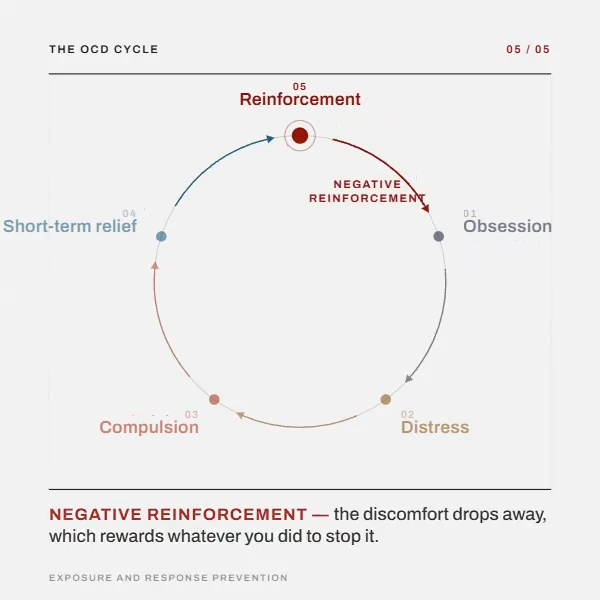
Fact: In OCD, reassurance seeking can function as a compulsion by proxy. Asking a partner whether they still love you after a hard week is ordinary. Asking the same question for the fifth time tonight, to get a feeling to go away, is a ritual. Salkovskis (1985) described how neutralizing behaviors, including ritualized reassurance seeking, provide short-term relief that prevents disconfirmation of the feared belief and strengthens the obsession over time. Family accommodation research shows the same pattern at home: when partners and parents answer “are you sure I didn’t hit someone” for the fifth time, symptoms get worse, not better.
A specialist will therefore decline to tell you that you are definitely not a pedophile, definitely did lock the door, definitely did not sin. Not because the answer is in doubt, but because answering feeds the loop. It can feel cold. It is the first relationship in years that has refused to become another ritual.
Myth 7: HOCD, POCD, ROCD, harm OCD, and scrupulosity are separate conditions
Fact: These are themes, not disorders. (Scrupulosity is the oldest of them; the acronyms are newer.) The Dimensional Obsessive-Compulsive Scale, one of the best-validated OCD measures, treats sexual, aggressive, and religious obsessions as a single “unacceptable thoughts” dimension precisely because they behave the same way clinically and statistically (Abramowitz et al., 2010; Wetterneck et al., 2015). Themes also migrate. A person whose OCD latches onto sexual orientation at 19 may find it on relationship doubt at 27 and on harming their newborn at 32. Same disorder, same mechanism, new content.
The acronyms are not harmless. They encourage people to research their theme rather than their disorder, and they hand OCD a new question to ruminate on: “but is mine really HOCD or something else?” That question is itself a mental ritual. Name the process, not the theme: I have OCD, and right now it is using this content.
Myth 8: People with pure O don’t avoid anything
Fact: Avoidance is the hidden compulsion inside the hidden compulsion. Because “pure O” gets defined by what is absent, people overlook what is quietly being subtracted from their lives. Not holding the baby. Not driving at night. Not praying at all, because praying “wrong” is worse. Not watching the news. Foa’s ERP model treats passive avoidance as functionally identical to active ritual, and response prevention has to include it (Foa et al., 2012). In my experience, the avoidance list is usually longer than the ritual list once we write it down.
Myth 9: If you can’t stop the thought, you’re doing it wrong
Fact: Trying to stop the thought is the wrong target, and the research on why is almost 40 years old. Wegner et al. (1987) showed that instructing people to suppress a thought (the famous white bear) produced a rebound: more of the thought, not less. Thought suppression is the compulsion that masquerades as a coping skill. Every OCD treatment worth the name is built on the opposite move: let the thought be present and change your response to it.
This is where inhibitory learning matters again. The success metric in modern ERP is not “the thought went away” or even “I felt less anxious.” It is “the thought was there, I did not ritualize, and I did the thing I was doing anyway” (Craske et al., 2014). Distress is allowed. Certainty is not required.
One tool: interrupt the ritual and leave it unfinished
Contamination clients have an obvious response-prevention target: hands off the soap. When your rituals are confessing, mentally reviewing, checking how you feel, arguing with the thought, or asking for reassurance, the equivalent is less obvious. Here is the one tool I teach first. It is not a substitute for treatment. It is what you can start today.
The principle: mental rituals are often reinforced by the temporary sense of relief, completion, or increased certainty they produce. That payoff tends to arrive as the ritual finishes. So you do not try to never start a ritual, which is impossible. You practice catching it mid-stream and leaving it incomplete.
Step 1: Catch it by its function, not its content. Ask one question: Am I doing this to feel more certain or less anxious? If yes, it is a ritual, regardless of how reasonable it looks. Replaying a conversation “to learn from it” is reviewing. Telling your partner “I had a weird thought today, is that normal?” is confessing plus reassurance. Scanning your body to see whether you felt something is checking.
Step 2: Name it out loud or in writing, in the plainest language available. “I’m checking.” “I’m confessing.” “I’m reviewing.” Naming shifts you from inside the ritual to observing it, and it strips the ritual of its disguise as problem-solving. Name the action. Do not name the theme.
Step 3: Stop in the middle. Not at a natural stopping point. The middle. If you are three sentences into a confession, stop at three. If you are halfway through re-examining what you said at the meeting, close the file half-read. If you were about to text your spouse the question, put the phone down with the text unsent. The unfinished quality is the exposure. It will feel wrong. That is the point.
Step 4: Say the uncertainty sentence and mean it as a hypothesis, not a comfort. “Maybe. I’m not going to find out right now.” The word maybe is doing the work. It does not say the feared thing is false (that is reassurance). It does not say it is true (that is agreeing with OCD). It concedes that the question is open and declines to close it. Concede, then commit.
Step 5: Return your attention to whatever you were doing before the ritual started, and expect the urge to come back. It will, usually within seconds. Repeat steps 1 through 4. You are not trying to win a single round. You are running reps that teach your brain something new about what happens when a ritual is left hanging: nothing.
Three worked examples, because the tool looks different by ritual.
Confessing. You are about to tell your partner about a violent image you had while holding the baby. Catch: “Am I telling them so they’ll say it’s fine?” Yes. Name: “I’m confessing.” Stop: mid-sentence if necessary. Uncertainty: “Maybe that thought means something. I’m not going to resolve that by telling you.” Return: keep holding the baby.
Mental checking. You are scanning for whether you felt a “groinal response” walking past someone. Catch: certainty-seeking. Name: “I’m checking.” Stop: quit the scan before it produces a reading. Uncertainty: “Maybe I felt something. I’m not going to figure out what it meant.” Return: keep walking.
Reviewing. You are on your fourth replay of an email to confirm it was not offensive. Catch: yes. Name: “I’m reviewing.” Stop: close the sent folder before you reach a verdict. Uncertainty: “Maybe I offended someone. I’ll live with not knowing.” Return: next task.
If you want the decision tree and a daily practice log for this, the Invisible Rituals Field Guide is the printable version.
Two cautions, both my clinical opinion. Do not use this tool to argue with OCD about whether something counts as a ritual; that debate is the ritual. And if interrupting spikes your anxiety enough to push you toward a bigger ritual later, shorten the reps rather than abandoning them. Ten interrupted rituals a day beats one heroic one.
When to get specialized help
Self-help tools are a floor, not a treatment plan. If intrusive thoughts and mental rituals are taking more than an hour a day, cost you relationships, work, or sleep, or if you have been in therapy for a while and it has never included the words “exposure” and “response prevention,” it is reasonable to consult with a clinician who specializes in OCD. Ask directly whether they use ERP and how they handle mental compulsions. A specialist will have an answer that sounds like this article. ERP has substantial empirical support, but individual response varies and no treatment works for everyone.
Frequently asked questions
References
Abramowitz, J. S., Deacon, B. J., Olatunji, B. O., Wheaton, M. G., Berman, N. C., Losardo, D., Timpano, K. R., McGrath, P. B., Riemann, B. C., Adams, T., Björgvinsson, T., Storch, E. A., & Hale, L. R. (2010). Assessment of obsessive-compulsive symptom dimensions: Development and evaluation of the Dimensional Obsessive-Compulsive Scale. Psychological Assessment, 22(1), 180–198. https://doi.org/10.1037/a0018260
Abramowitz, J. S., Franklin, M. E., Schwartz, S. A., & Furr, J. M. (2003). Symptom presentation and outcome of cognitive-behavioral therapy for obsessive-compulsive disorder. Journal of Consulting and Clinical Psychology, 71(6), 1049–1057. https://doi.org/10.1037/0022-006X.71.6.1049
American Psychiatric Association. (2022). Diagnostic and statistical manual of mental disorders (5th ed., text rev.). https://doi.org/10.1176/appi.books.9780890425787
Baer, L. (1994). Factor analysis of symptom subtypes of obsessive compulsive disorder and their relation to personality and tic disorders. Journal of Clinical Psychiatry, 55(Suppl.), 18–23.
Craske, M. G., Treanor, M., Conway, C. C., Zbozinek, T., & Vervliet, B. (2014). Maximizing exposure therapy: An inhibitory learning approach. Behaviour Research and Therapy, 58, 10–23. https://doi.org/10.1016/j.brat.2014.04.006
Foa, E. B., Yadin, E., & Lichner, T. K. (2012). Exposure and response (ritual) prevention for obsessive-compulsive disorder: Therapist guide (2nd ed.). Oxford University Press.
Freeston, M. H., Ladouceur, R., Gagnon, F., Thibodeau, N., Rhéaume, J., Letarte, H., & Bujold, A. (1997). Cognitive-behavioral treatment of obsessive thoughts: A controlled study. Journal of Consulting and Clinical Psychology, 65(3), 405–413. https://doi.org/10.1037/0022-006X.65.3.405
Glazier, K., Calixte, R. M., Rothschild, R., & Pinto, A. (2013). High rates of OCD symptom misidentification by mental health professionals. Annals of Clinical Psychiatry, 25(3), 201–209.
Glazier, K., Swing, M., & McGinn, L. K. (2015). Half of obsessive-compulsive disorder cases misdiagnosed: Vignette-based survey of primary care physicians. Journal of Clinical Psychiatry, 76(6), e761–e767. https://doi.org/10.4088/JCP.14m09110
Rachman, S. (1997). A cognitive theory of obsessions. Behaviour Research and Therapy, 35(9), 793–802. https://doi.org/10.1016/S0005-7967(97)00040-5
Radomsky, A. S., Alcolado, G. M., Abramowitz, J. S., Alonso, P., Belloch, A., Bouvard, M., Clark, D. A., Coles, M. E., Doron, G., Fernández-Álvarez, H., Garcia-Soriano, G., Ghisi, M., Gomez, B., Inozu, M., Moulding, R., Shams, G., Sica, C., Simos, G., & Wong, W. (2014). Part 1—You can run but you can’t hide: Intrusive thoughts on six continents. Journal of Obsessive-Compulsive and Related Disorders, 3(3), 269–279. https://doi.org/10.1016/j.jocrd.2013.09.002
Ruscio, A. M., Stein, D. J., Chiu, W. T., & Kessler, R. C. (2010). The epidemiology of obsessive-compulsive disorder in the National Comorbidity Survey Replication. Molecular Psychiatry, 15(1), 53–63. https://doi.org/10.1038/mp.2008.94
Salkovskis, P. M. (1985). Obsessional-compulsive problems: A cognitive-behavioural analysis. Behaviour Research and Therapy, 23(5), 571–583. https://doi.org/10.1016/0005-7967(85)90105-6
Salkovskis, P. M., & Harrison, J. (1984). Abnormal and normal obsessions—A replication. Behaviour Research and Therapy, 22(5), 549–552. https://doi.org/10.1016/0005-7967(84)90057-3
Wegner, D. M., Schneider, D. J., Carter, S. R., & White, T. L. (1987). Paradoxical effects of thought suppression. Journal of Personality and Social Psychology, 53(1), 5–13. https://doi.org/10.1037/0022-3514.53.1.5
Wetterneck, C. T., Siev, J., Adams, T. G., Slimowicz, J. C., & Smith, A. H. (2015). Assessing sexually intrusive thoughts: Parsing unacceptable thoughts on the Dimensional Obsessive-Compulsive Scale. Behavior Therapy, 46(4), 544–556. https://doi.org/10.1016/j.beth.2015.03.006
Williams, M. T., Farris, S. G., Turkheimer, E., Pinto, A., Ozanick, K., Franklin, M. E., Liebowitz, M., Simpson, H. B., & Foa, E. B. (2011). Myth of the pure obsessional type in obsessive-compulsive disorder. Depression and Anxiety, 28(6), 495–500. https://doi.org/10.1002/da.20820
Williams, M. T., Mugno, B., Franklin, M., & Faber, S. (2013). Symptom dimensions in obsessive-compulsive disorder: Phenomenology and treatment outcomes with exposure and ritual prevention. Psychopathology, 46(6), 365–376. https://doi.org/10.1159/000348582
This article is for educational purposes only and does not constitute therapy, diagnosis, or a professional relationship. If you are in crisis, call or text 988 in the United States.
Felix Murad, M.Ed., LPC-S, LMHC, CMHC, NCC | Licensed Professional Counselor-Supervisor | Licensed by the Texas Behavioral Health Executive Council, Texas State Board of Examiners of Professional Counselors | Licensed in Texas, Washington, and New Hampshire; registered for out-of-state telehealth in Florida.
NEXT STEP
Ready to work with a specialist who treats mental compulsions as compulsions?
Book a free 15-minute consult call to find out whether ERP with Murad Counseling is the right fit. The call is a fit conversation, not a session, and there is no obligation to begin.
Consultation requests are kept confidential; please do not send detailed clinical history through a general contact form.