
Why Reassurance Seeking Makes OCD Worse

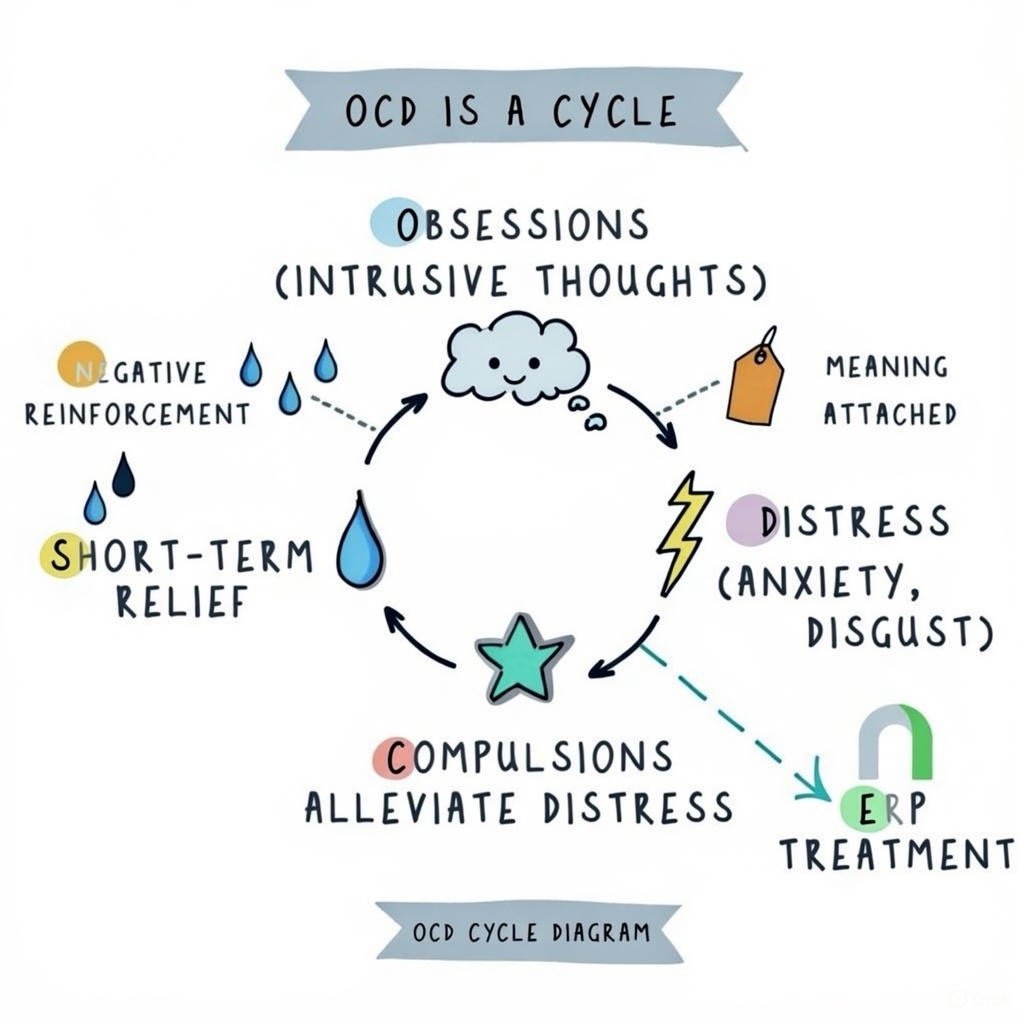
If you have OCD, reassurance can feel like oxygen. The intrusive thought hits, the anxiety spikes, and the question comes out before you have even decided to ask it: Are you sure I locked the door? Does that seem normal to you? You don’t think I’m a bad person for having that thought, do you?
Reassurance seeking is not a character flaw. It is one of the most common compulsions in OCD. On the surface, it looks reasonable: you feel uncertain, so you ask for certainty. In OCD treatment, though, the function matters. Reassurance feels responsible, but it usually trains the loop.
What Is Reassurance Seeking in OCD?
Reassurance seeking is any behavior designed to reduce uncertainty or anxiety by obtaining confirmation that the feared outcome hasn’t occurred or won’t occur. In OCD, this can look like:
- Asking a partner, parent, or friend if they think you’re a good person
- Googling symptoms to confirm you don’t have a disease
- Texting someone to confirm they’re not angry with you
- Asking a therapist repeatedly whether a thought means something about your character
- Mentally reviewing a past event to confirm you didn’t do anything wrong
- Checking online forums for reassurance that your intrusive thoughts are “normal”
That last item matters. Reassurance seeking is not only external. Mental compulsions are just as much compulsions as behavioral ones. They are often harder to catch because nobody else can see the checking happening.
Why It Feels Like It Helps (And Why It Doesn’t)
Reassurance works in the short term. You ask. Someone answers. The anxiety drops. That drop is the hook.
The problem is what happens next. The relief lasts until the next trigger, and the next trigger usually comes faster. Then the question has to be asked again, with more detail, more urgency, or a slightly different angle.
The brain learns two things from the cycle: the fear was important enough to check, and reassurance was the correct response. That is how a kind answer becomes fuel for OCD.
Salkovskis (1985, 1989) was among the first to formalize the cognitive model of OCD that explains this clearly: compulsions, including reassurance seeking; prevent the disconfirmation of the feared outcome. The fear never gets tested. The uncertainty never gets tolerated. The brain never learns that the threat was not as credible as it felt.
The Reassurance Trap: It Keeps Moving
One of the most frustrating features of reassurance seeking in OCD is that it doesn’t stay in one place. When one source of reassurance is removed or becomes unreliable, the person finds another.
Someone who has stopped asking their partner for reassurance may start Googling instead. Someone who has stopped Googling may start mentally reviewing the situation in exhaustive detail. Someone who recognizes mental review as a compulsion may start checking in with their therapist at every session for confirmation that they’re doing the work correctly. The content of the fear does not change the mechanism: reassurance seeking about a loved one’s safety can look like ordinary care right up until the calls and check-ins cannot stop.
This “migration” of reassurance-seeking behavior is extremely common and does not mean the person is failing at treatment. It means the OCD is adaptive and will route around obstacles to find the relief it’s looking for. Exposure and Response Prevention is designed specifically to address this.
What Family Members and Partners Often Don’t Realize
Most people who love someone with OCD provide reassurance out of genuine compassion. When your partner is distressed, you want to help. Saying “You’re fine, I promise” seems kind. And in the moment, it does help; which is exactly why the person asks again tomorrow.
This pattern is called accommodation, and research consistently shows that high levels of family accommodation are associated with more severe OCD, poorer treatment outcomes, and higher rates of relapse (Calvocoressi et al., 1999; Storch et al., 2007).
That does not mean family members are doing something wrong by caring about their loved one’s distress. It means that the most compassionate response to OCD is not the most intuitive one. Learning how to respond to reassurance-seeking requests; warmly but without providing the reassurance; is a skill. It is also something that can be worked on in treatment.
The OCD Logic Problem
People with OCD often understand, intellectually, that seeking reassurance makes things worse. They have read the books. They know the cycle. And they still do it, because in the moment, the anxiety is not intellectual. It is urgent and visceral and feels like actual threat.
This is not a failure of willpower or insight. It is a feature of how OCD hijacks the threat-detection system. The prefrontal cortex knows the thought is irrational. The limbic system doesn’t care.
If this pattern is showing up in your life, treatment usually needs more than reassurance. Learn how ERP therapy for OCD targets the fear loop directly.
This is part of why OCD therapy needs to work at the level of behavior and habituation, not just insight. Understanding why reassurance seeking is counterproductive is useful. But understanding alone does not extinguish the compulsion. Inhibitory learning; the process of building new associations through repeated, deliberate non-engagement with the compulsion; is what produces lasting change.
What ERP Actually Does About This
In Exposure and Response Prevention (ERP), the “response prevention” component is precisely about learning to tolerate uncertainty without seeking reassurance.
This doesn’t mean white-knuckling through panic. It means deliberately exposing yourself to the triggering thought or situation, and then refraining from the compulsive response, including the urge to seek reassurance; long enough for the nervous system to learn that the anxiety will pass and that nothing catastrophic happens in its absence.
Over repeated trials, the brain builds what researchers call an inhibitory memory: a new learning that competes with the fear memory. The obsession can still trigger anxiety, but the anxiety is no longer amplified by the compulsion, and the person develops a different relationship with the uncertainty.
For reassurance-seeking compulsions specifically, exposures might look like:
- Purposely sitting with an intrusive thought without asking anyone about it
- Closing Google before finding a confirming answer
- Deliberately ending a mental review mid-cycle
- Having a conversation with a loved one and not checking whether they’re upset afterward
These are not easy tasks. They feel counter-intuitive at first. But research consistently supports ERP as the gold-standard behavioral treatment for OCD, with the highest evidence base of any psychological intervention for the disorder.
A Note on Taboo and Ego-Dystonic Thoughts
Reassurance seeking is especially common in presentations where the intrusive thoughts are shameful or disturbing in content; what are sometimes called taboo thoughts in OCD. These might involve fears of harm, unwanted sexual thoughts, religious themes, or concerns about one’s identity or values.
Because the thoughts feel so foreign and disturbing, the person desperately wants someone to confirm that having the thought doesn’t mean anything about who they are. This is understandable. And it is still a compulsion.
The most therapeutic response to “Does this thought mean I’m a bad person?” is not no. It is learning to tolerate not knowing; which is, paradoxically, where genuine relief lives.
Related OCD Resources
If reassurance has become the main way you manage OCD, these pages explain what tends to replace it in treatment.
- Mental Rituals in OCD: why reassurance can also happen silently through review, checking, and analysis
- Why ERP Actually Works: how treatment builds new learning without feeding the reassurance cycle
- ACT for OCD: how values-based action helps when OCD demands certainty
- ERP Therapy: the broader treatment page for exposure and response prevention
When to Get Help
If reassurance seeking is a significant part of your OCD picture; if you find yourself spending hours each day checking, asking, reviewing, or Googling; that is information worth taking seriously. Not because it means something is deeply wrong with you, but because it tells you that the compulsive cycle is well-established and probably has been for some time.
Good OCD treatment works. ERP, delivered by a clinician who actually understands the disorder, produces meaningful change for the majority of people who engage with it consistently. The question is not whether you can get better. The question is whether you have access to the right kind of help.
If reassurance has become the thing your day is organized around, the next step is not a better answer. It is a different response. Schedule a consultation call, and we can talk through what ERP would actually require.
Felix Murad, M.Ed., LPC-S, LMHC, CMHC, NCC is a licensed counselor practicing via telehealth in Texas, Washington, and New Hampshire, and registered to provide telehealth in Florida. He specializes in OCD, ERP, and anxiety disorders. Felix provides supervision and consultation services to professionals and organizations.