BFRB THERAPY · TELEHEALTH FOR ADULTS IN NEW HAMPSHIRE
BFRB Therapy in New Hampshire for Hair Pulling & Skin Picking
Specialized online treatment for trichotillomania (hair pulling), excoriation disorder (skin picking), and related body-focused repetitive behaviors, for adults who are physically located in New Hampshire at the time of session. Treatment is built from your actual pattern, not from willpower.

When does a habit become a BFRB?
Most people occasionally pull, pick, or bite. A body-focused repetitive behavior is different in kind, not just in amount. These are the markers I look for in a first conversation.
Hair pulling and skin picking are related, but they are not the same problem
Trichotillomania and excoriation disorder share a reinforcement loop, and one person can have both. Effective treatment still needs to know which behavior it is working with, whether the episodes are automatic or focused, and what cues them.
Trichotillomania involves pulling hair from the scalp, eyebrows, eyelashes, or other body areas, often driven by the desire for a specific texture. It may also include post-pulling behaviors like examining or rolling the hair.
Excoriation disorder: picking at skin on the face, arms, cuticles, or back, usually cued by a bump, scab, or perceived imperfection, with the mirror a frequent trigger zone.
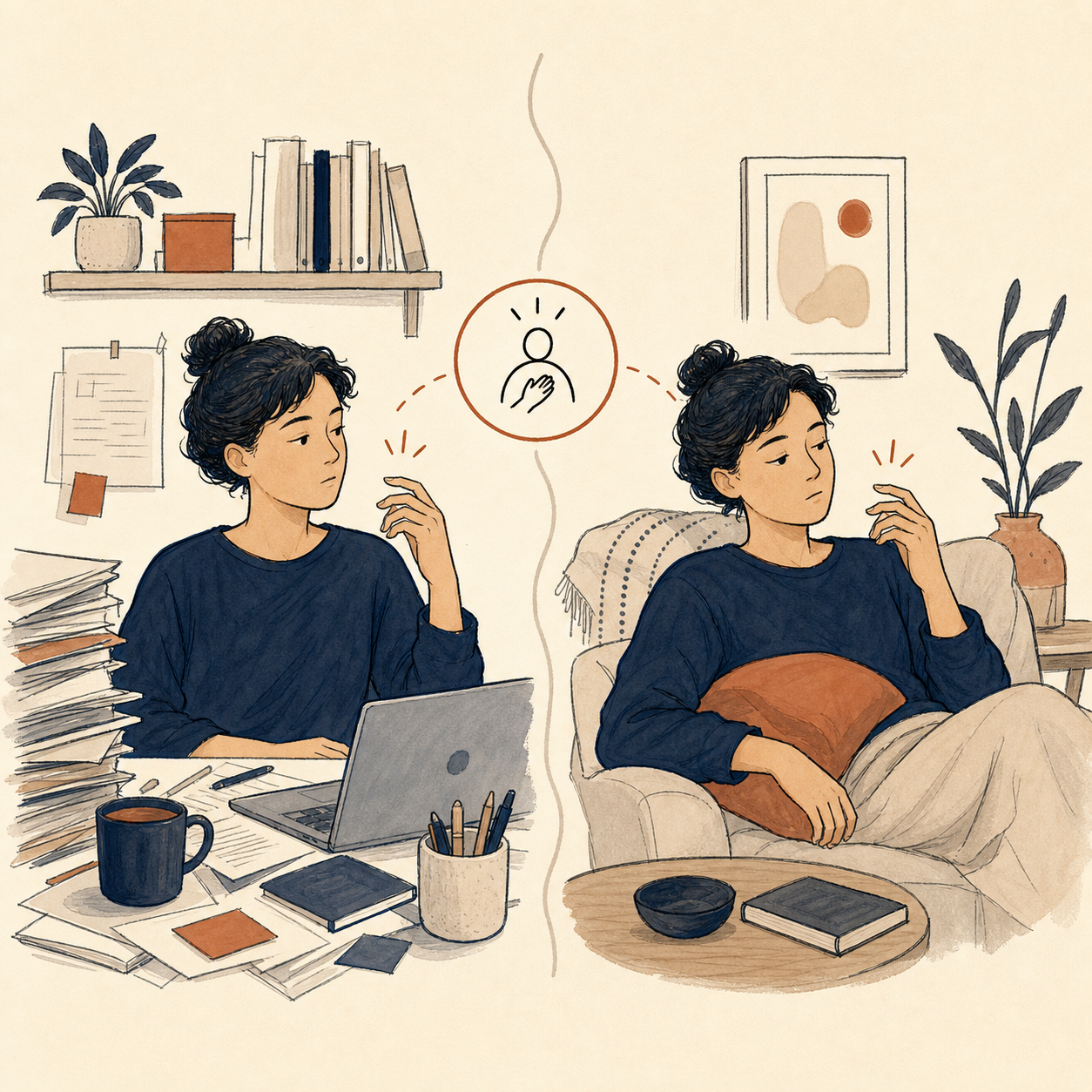
Automatic behavior: the hand is already there as you read, drive, scroll, or watch TV. You notice the pile of hair or the bleeding, not the decision.
Focused behavior: you go to the bathroom or to a mirror on purpose, hunting for coarse hair or a rough patch, often in a trance-like, absorbed state.
Sensory and environmental triggers: bright lighting, magnifying mirrors, tweezers within reach, idle hands, late evenings, and long periods at a desk.
Emotional and cognitive triggers: boredom, tension, frustration, perfectionistic thoughts about a flaw, and the pull to feel even or finished.
THE REINFORCEMENT LOOP
Why telling yourself to just stop has not worked
Every episode of pulling or picking does something in the moment: it settles tension, interrupts boredom, sharpens focus, smooths a rough edge, or produces a small hit of completion. That payoff arrives within seconds and teaches your nervous system to repeat the behavior the next time the same cue appears. Shame and willpower add pressure after the fact, but they do not change the cue, the urge, the sensory pull, or the environment, which is why the pattern keeps returning even when you badly want it gone.
A BFRB is also not a simple bad habit and not OCD. OCD is maintained by intrusive doubt and compulsions meant to neutralize uncertainty, which is why exposure and response prevention fits OCD. BFRBs are maintained by sensory, motor, emotional, and environmental reinforcement, so treatment targets that loop directly instead of treating your hands as the enemy.
How specialized BFRB treatment works
The core treatment is Habit Reversal Training, individualized through the Comprehensive Behavioral (ComB) model and supported by acceptance-based work when urges and emotions drive the loop. These components form the basis of the sessions.
Awareness training
Learning to catch the earliest part of the sequence: the hand drifting up, the scanning, the first touch. Awareness creates a choice point before the episode is already underway.
Functional assessment and trigger mapping
Recording where, when, and how episodes occur, and what they do for you in the moment, so the plan targets the sensory, emotional, cognitive, motor, and environmental cues that actually matter.
Competing responses
Practicing a planned action that is physically incompatible with pulling or picking, used at the moment of urge and held until the urge passes, then refined based on what works in your real-world settings.
Stimulus control and environmental change
Adjusting lighting, mirrors, tool access, hand occupation, and high-risk time windows to make the behavior harder to start and easier to interrupt.
ComB individualized formulation
Sorting your pattern into sensory, cognitive, affective, motor, and place domains, then choosing interventions that match your strongest drivers rather than using a generic checklist.
Acceptance-based work (ACT)
When urges feel unbearable or self-criticism keeps the cycle going, acceptance and commitment strategies help you make room for the urge without acting on it and keep treatment aligned with what matters to you.
What treatment with me looks like
I am Felix Murad, the only clinician at Murad Counseling. When you work with me on hair pulling or skin picking, you work with me directly at every session.
Targets that tell us whether treatment is working
Awareness of episodes
How early you notice an episode starting, and how often you catch it before the first pull or pick rather than afterward.
Antecedents and time windows
The situations, moods, and times of day that reliably come before the behavior, mapped over several weeks rather than guessed.
Environmental cues
Mirrors, lighting, tools, seating, and screens that make the sequence easier to start, and which changes actually reduce episodes.
Urge patterns
How intense urges get, how long they last, and whether they peak and pass when you use a competing response instead of acting.
Competing response use
Which planned responses you actually use in real settings, how long you hold them, and where they need to be adjusted.
Concealment and interference
Time spent covering, checking, or avoiding, and the activities you have started to reclaim, from haircuts to swimming to sleeves you can push up.
NEW HAMPSHIRE TELEHEALTH
Online BFRB therapy for adults across New Hampshire
I hold a Clinical Mental Health Counselor (CMHC) license in New Hampshire, which allows me to provide telehealth therapy to adults who are physically located in the state during each session, whether you are in Manchester, Nashua, Concord, the Seacoast, the Lakes Region, or a small town with no BFRB specialist within driving distance. This practice does not have a physical office in New Hampshire.
Telehealth suits BFRB work unusually well: the behavior happens at your desk, in your bathroom, and on your couch, and video sessions let us look at those real settings, test environmental changes where they will actually be used, and review your between-session records together. Sessions are private pay; current fees and the limited insurance options are listed on the pricing page.
RELATED RESOURCES
Go deeper on the specific behavior
This page is the starting point for New Hampshire adults. The pages below cover each behavior and method in depth.
Frequently Asked Questions
Ready to work on hair pulling, skin picking, or another BFRB from anywhere in New Hampshire?
A free 15-minute consultation is the first step. No pressure to commit, and no judgment about how long this has been going on.